
Architecture & Facilities
at Zion Mennonite Church
The Theological Significance of the Complex As A Whole
The architecture of the complex seeks to embody, in brick, concrete, and glass, the Anabaptist vision of the Church as a disciplined, gathered community of believers. When choosing an architect, the congregation spent two years studying their history and theology before making a choice. Edward A. Sövik of Northfield, Minnesota, was chosen for his sensitivity to Anabaptist thought. He immersed himself in the denomination’s writings, honoring the congregation’s request that he be guided by tradition without being confined by it.
The design draws from two main sources: the Anabaptist vision of the Church as a gathered community and Philippians 2:5-7, where Christ “emptied himself” and took “the form of a servant.” The complex’s clean lines and honest use of materials reflect these principles. Sövik believed the building itself should serve as Christ does—strong, well-equipped, and humble, yet never ostentatious. It was not to stand as a monument demanding awe, but as a servant inviting use: “I am your servant. Come in and use me.”
The Centrally Located Cross
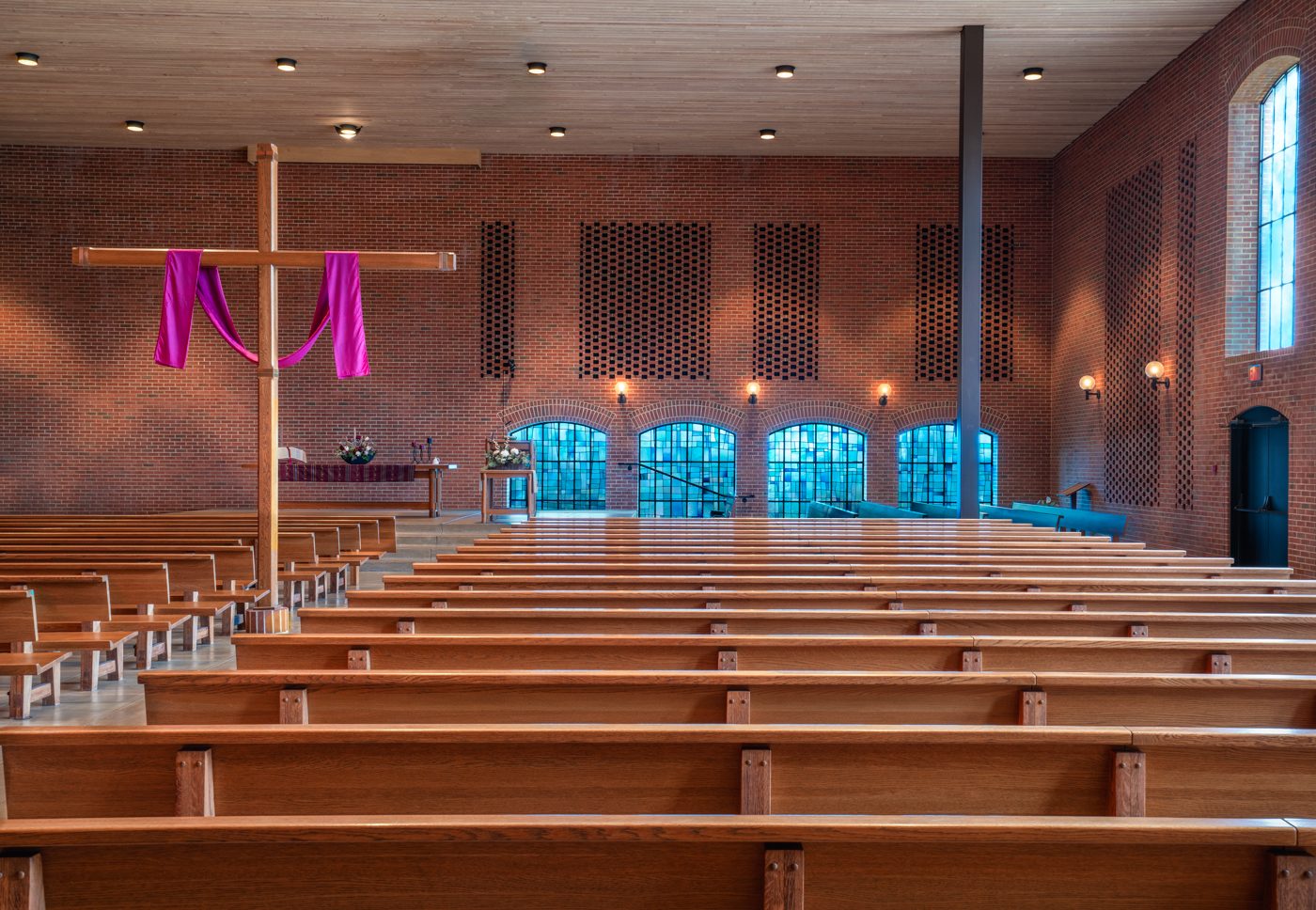
The cross is located in the center of the worship space as an analogy of the place of Christ in history — the gathering point of all that went before and comes after. The Incarnation is the pivotal event, giving meaning to all that surrounds it — the model of God’s involvement in the life of the world. Christ’s entrance into earthly history established for Christians their position in relation to the world and history. They must see themselves not detached from but passionately involved in the middle of human society and action.
This central location of the cross has also a distinctly Anabaptist character. Rather than being an ornament of decoration on the altar, it is planted in the midst of the gathered congregation. The Anabaptist stressed not only what Christ did for us on his cross, but also the fact that every Christian is called to deny himself, take up his own cross, and follow after Christ.
Discipleship (or Nach-folge Christi) was the key word in the Anabaptist vision of the church as a community of gathered and disciplined believers.
The Asymmetrical Arrangement
of the Sanctuary
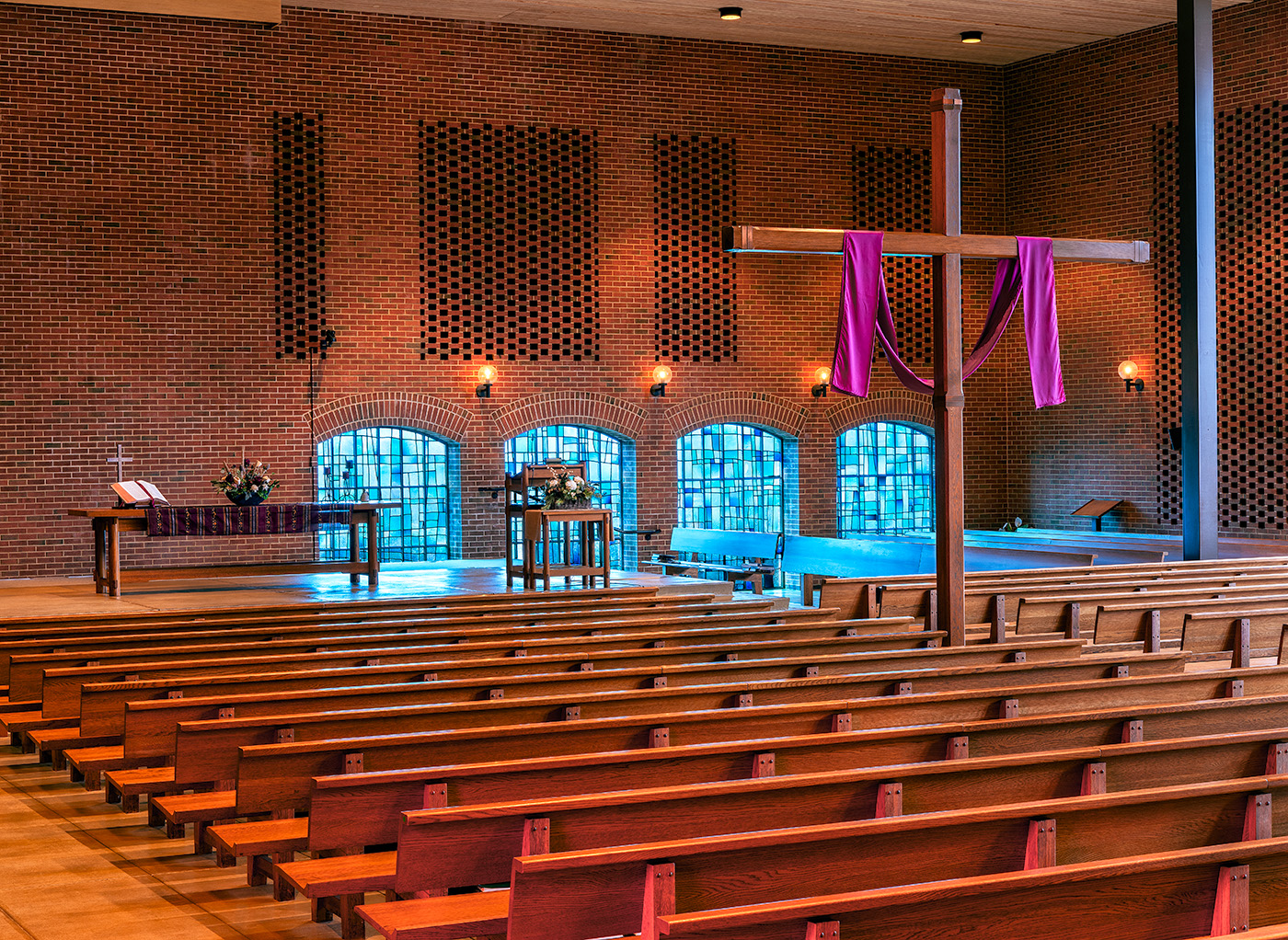
While the cross is centrally located in the worship space, everything else in it is deliberately placed in an asymmetrical or off-center arrangement.
The central location of the cross and the asymmetrical arrangement of all the remaining space are symbolical ways of saying two very important things about the Christian faith and its relationship to a constantly changing world. As Christians we know Christ is at the center of our faith, and we do not anticipate the coming of another Christ, who will make this one obsolete, but rather the return of the same Christ.
What we do not know, however, is the full implications of our faith for all time to come. New discoveries in the atomic and space age do not make Christ obsolete. They only reveal nuances of meaning and depths of significance in him, which were previously hidden from us. The task of writing Christian theology, i.e., interpreting the Christian faith, is therefore never complete. We can build on what other generations have done, but our task is not that of simply memorizing earlier interpretations.
Each generation of Christians must hammer out the implications of the central event of our faith for its own time.
The Baptismal Font
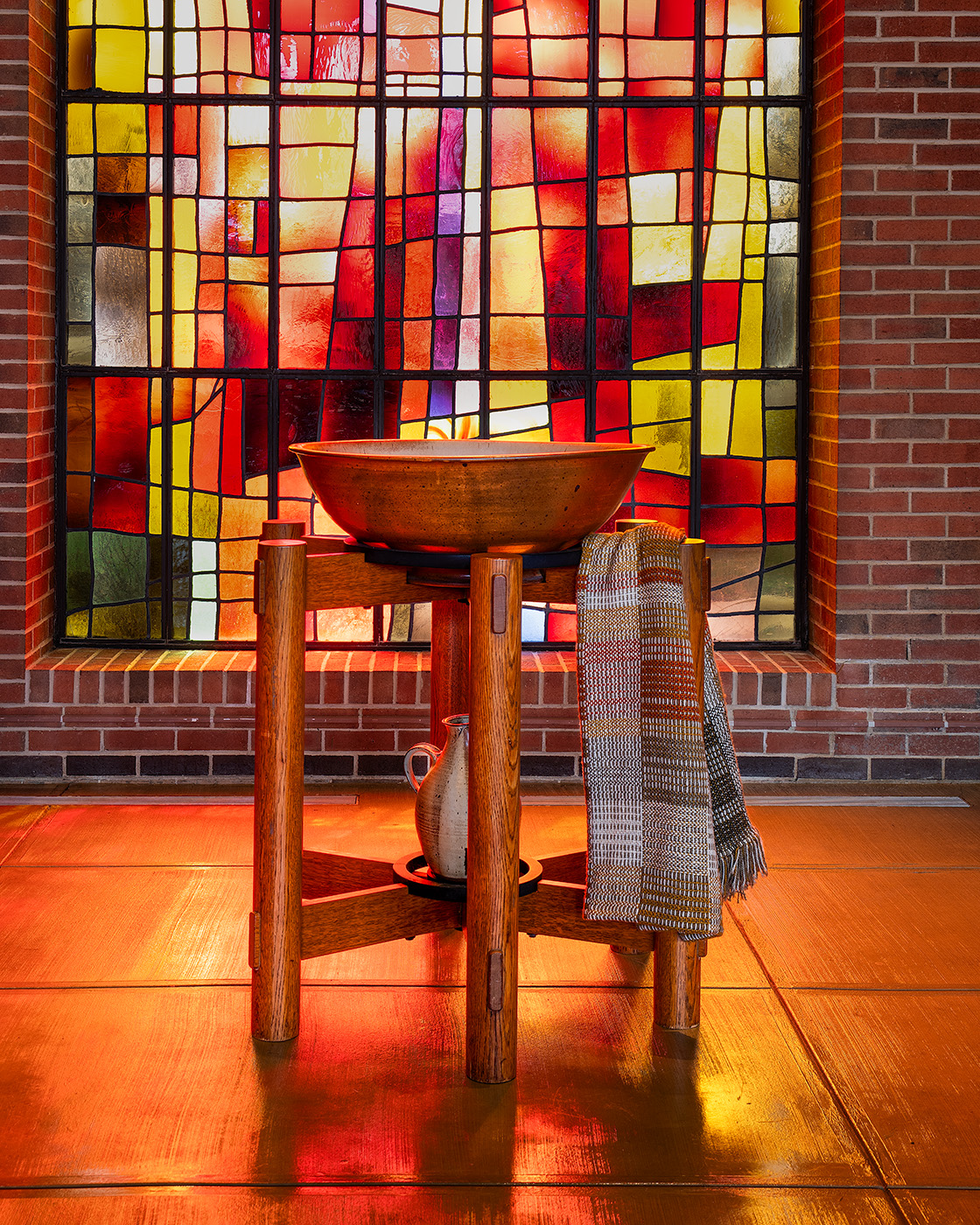
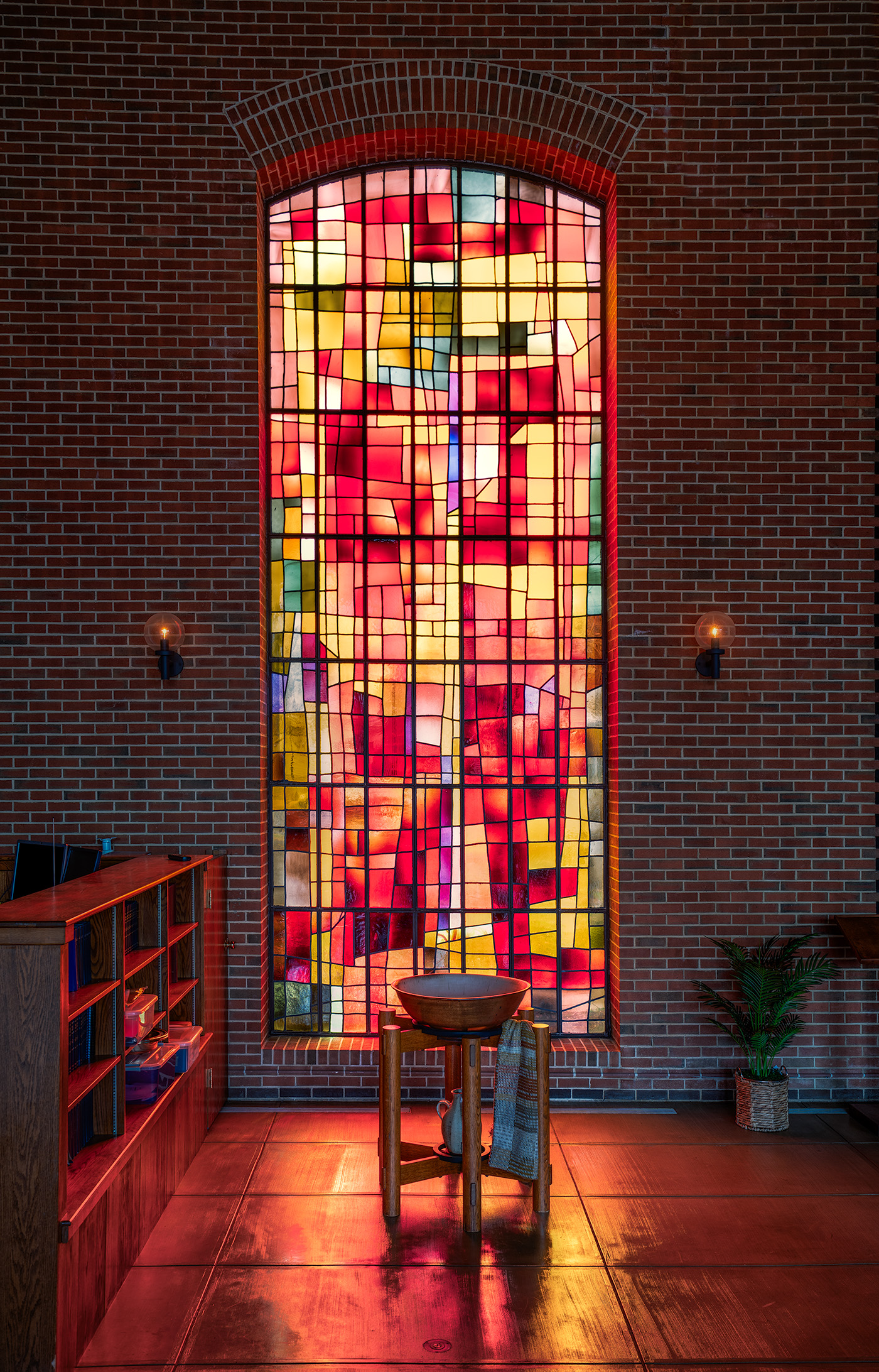
The baptismal font, fashioned out of clay and fired until it has become stoneware, is purposely placed in front of the baptismal window. Here it serves to remind all that enter the church, that by means of baptism we are incorporated into the Church as Christ’s “Suffering Body” on earth. Our call, like that of the martyrs before us, is to be faithful, if need be, “even unto death.”
The towel on the baptismal stand is a symbolic way of saying that while baptism may not always be baptism into suffering and death, it will always be baptism into service.
The Baptismal Window
The baptismal window is the result of an effort to capture the Anabaptist theology of baptism by relying alone on the color of the glass. The two predominant colors are red – the red of fire and the red of blood. Together they comprise what Edward A. Sövik described as the paradoxical combination of the terrible and the beautiful.
Baptismal WindowThe first Anabaptist martyr, Felix Mantz, died in January of 1525. By 1529 Anabaptists were outlawed by imperial decree in every nation in Europe. To be apprehended and identified as an Anabaptist was to be automatically under the death sentence. Methods of execution of an Anabaptists were beheading, burning at the stake, and drowning.
Since Anabaptists were persuaded that God had called them to renew Christ’s Church through adult or Believer’s Baptism, they were not at liberty to discontinue this practice because the emperor had ordered them to do so. Instead, they developed a theology of baptism to match the suffering they had to endure. Baptism, they said, is incorporated into the Church of Christ as his “Suffering Body” on earth.
What is lacking in Christ’s own suffering is completed through the suffering of the martyrs on earth, and his reconciling ministry is continued. Baptism is death and burial with Christ. The deeper red in the window symbolizes the red of the blood of the beheaded martyrs, and the brighter red, the red of fire that burned them to death at the stake. This brighter red may also stand for the gift of the Holy Spirit, by which the Church is born, and the Anabaptist conviction that the Christian life in this world is walking in the power of the Resurrection.
The Blue Windows
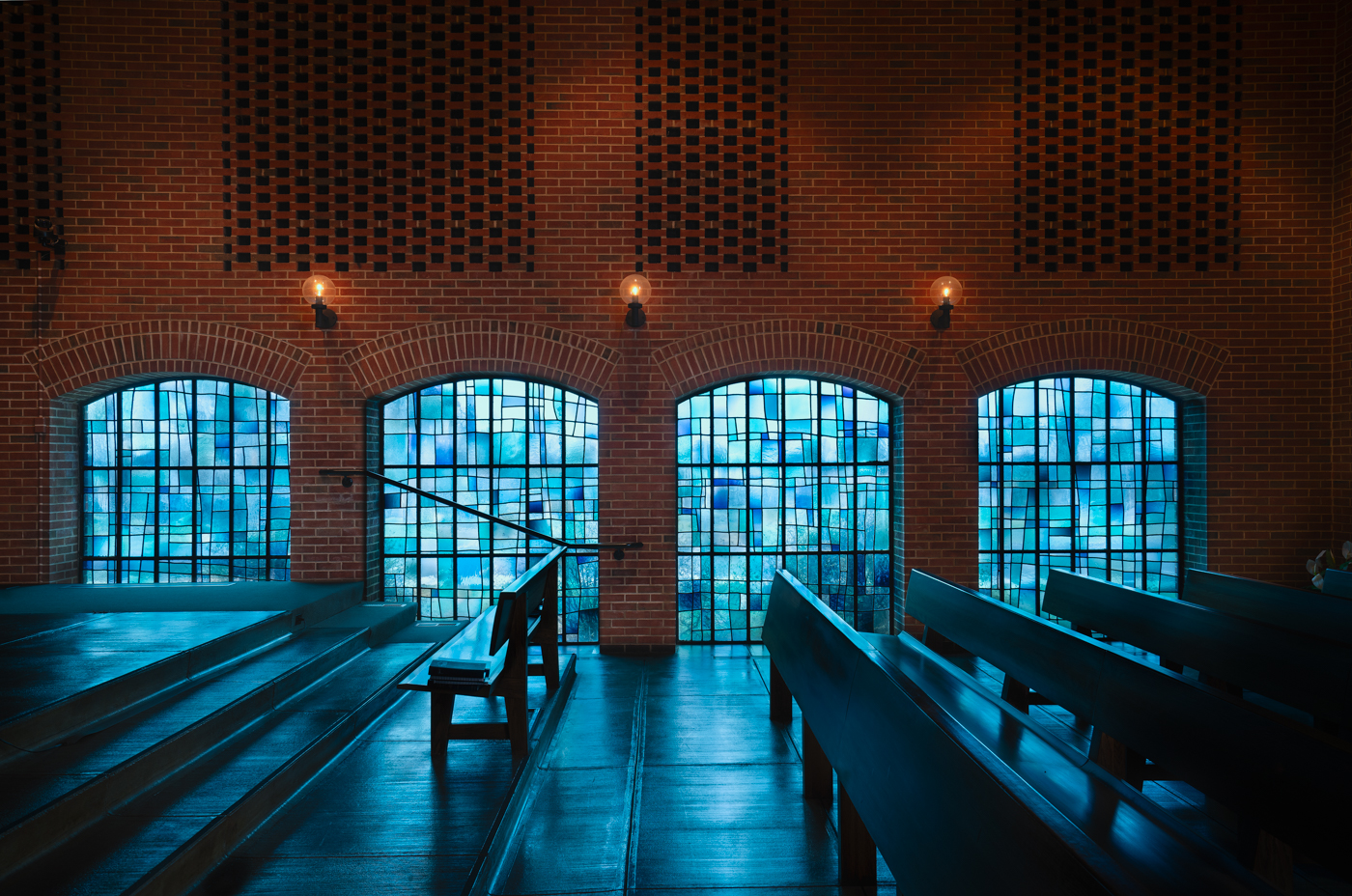
The architect, Edward A. Sövik, in a letter to the people at Willet Stained Glass Studios, expressed his hope for the blue windows in this fashion: “My hope is that they will not intensify the character of the space within the room, but by serving as a veil imply that there is a sort of eschatological infinity beyond the immediate.”
Eschatology may be a strange word to most people, yet no Christian can live long in this world as an obedient disciple of Jesus Christ without the conviction that God will have the last word.
This vision of a future Kingdom of Perfection, by which all our present activities are both judged and redeemed, is absolutely essential to prevent the present order from becoming either sterile or demonic. “For now we see through a glass, darkly; but then face to face; now I know in part; but then shall I know even as also I am known.” This requires of us an openness to the possibility that more of God’s truth may break through into our present order and call us to new forms of obedience in a world that is constantly changing. It is a reminder to us that until time shall end, the kingdoms of this earth will stand under the judgment of the Kingdom that is coming.
Only as we live in that awareness are we safe from the demonic. Rightly understood, however, the Christian hope of a future Kingdom of Perfection means not escape from the present world but living responsibly in it, under God.
There are, therefore, three types of windows in this sanctuary: the baptismal window, which reminds the Christian of his own commitment to Christ and witnesses to the tradition Christian hope of a coming Kingdom of Perfection; and the tall clear glass windows, which calls the Christian, as one rooted in the past and grounded in the future hope, to serve the present age, which is ever visible through the clear windows.
Cemetery
Solar Project
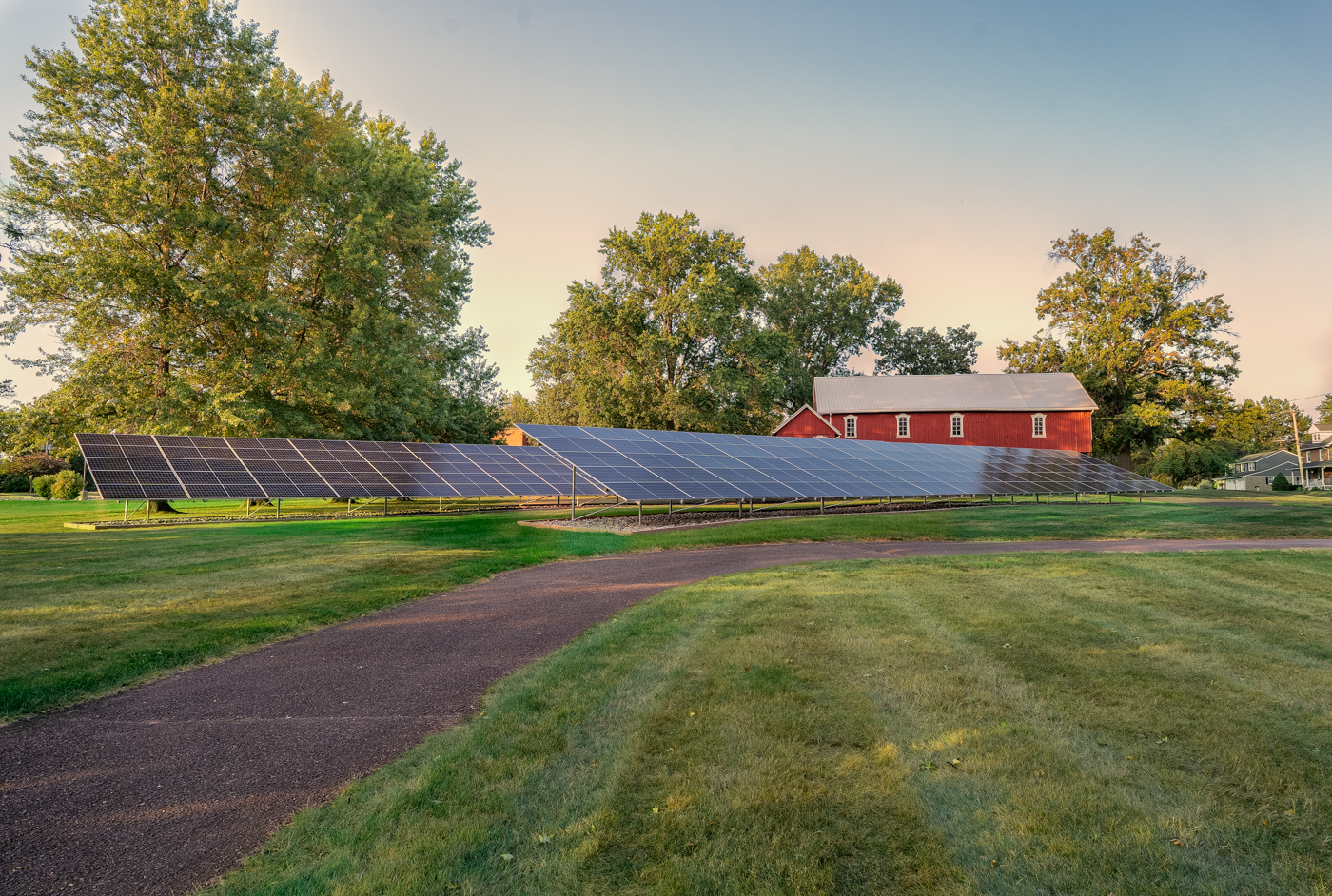
Zion Mennonite Church’s solar array was installed in 2024.